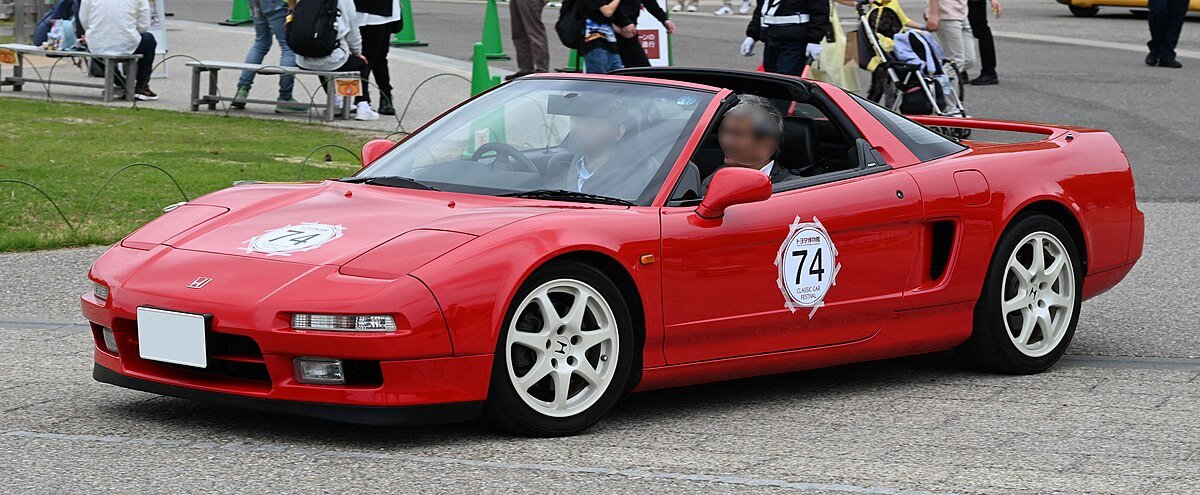
Honda NSX (1990-2005) – Supersport každodenní použitelnosti
První NSX revolucionalizoval segment supersportů díky celohlíníkové karoserii a spolehlivosti Ferrari překonávající.
Nový standard supersportů
Honda NSX byl představen v roce 1990 jako první masově vyráběný vůz s celohlíníkovou karoserií. Cílem bylo vytvořit supersport s použitelností běžného vozu.
Spolupráce s Ayrtonem Sennou
Legendární pilot F1 Ayrton Senna se podílel na vývoji podvozku a řízení. Jeho zpětná vazba vedla k tužšímu nastavení a přesnějšímu řízení.
Technické inovace
- Celohlíníková monokok karoserie (první v sérii)
- Motor V6 VTEC uprostřed
- Titanové ojnice
- Elektronicky ovládaný systém VTEC
NSX Type R
V roce 1992 Honda představila NSX Type R s odlehčenou karoserií (1230 kg) a výkonově upraveným motorem.
Přehled
The first generation Honda NSX (marketed in North America and Hong Kong as the Acura NSX ) is a 2-seater, mid-engine sports car that was manufactured by Honda in Japan from 1990 until 2006.
Around 1984, Honda engineers began experimenting with different engine and chassis layouts to test viability for future products. One of the test mules was a Honda City that had been cut in half, with the engine installed behind the driver's seat and powering the rear wheels. Although the project was not developed any further, many of the engineers were inspired by the exciting laps around the company parking lot in the mid-engined City. This experience, in part, convinced Honda leadership that the company should consider developing a pure sports car. As a result, in 1984, Honda commissioned the Italian car styling house Pininfarina to design the concept car HP-X (Honda Pininfarina eXperimental), which had a C20A 2.0 L V6 engine in a mid-mounted configuration. After Honda committed to a sports car project, the company management informed the engineers working on the project that the new car would have to be as fast as anything coming from Italy and Germany. The HP-X concept car evolved into a prototype known as NS-X , which stood for " N ew", " S portscar" "e X perimental". The prototype and eventual production model—which was marketed as the NSX —were designed by a team led by Honda Chief Designer Masahito Nakano, and Executive Chief Engineer Shigeru Uehara (who were subsequently placed in charge of the S2000 project).
The original performance target for Honda's new sports car was the Ferrari 328 (and later, the 348 ) as the design neared completion. Honda intended its sports car to meet or exceed the performance of the Ferrari, while offering superior reliability and a lower price. For this reason, the 2.0 L V6 engine utilised in the HP-X was shelved and ultimately replaced with a significantly more powerful 3.0 L VTEC V6 engine. Over the course of development of the NSX, many engines were used, ranging from the 2.7-litre single overhead camshaft V6 engine from the Honda Legend/Honda Coupé to the 3.0-litre single overhead camshaft V6 engine, used subsequently in 15 test mules. Honda eventually settled on a non- VTEC , 3.0-liter double overhead camshaft 24-valve V6 engine selected for the production model. This engine generated a maximum power output of about 250 hp (186 kW; 253 PS) and 282 N⋅m (208 lb⋅ft) of torque, with a redline of 7,300 rpm. However, at the same time, Honda was working on its revolutionary VTEC variable valve timing system, with plans to release it on the company's home-market 4-cylinder Integra . Honda's then-president Tadashi Kume , himself a highly skilled and respected engine designer, questioned the NS-X designers' logic in foregoing the VTEC system for Honda's new flagship sports car, while it was being used on the lower-market Integra . As a result, the engine was redesigned very late in the development process "to achieve the desired levels of performance and durability"; Honda designed a new cylinder block with 6-bolt main caps and larger cylinder heads to contain the complex VTEC mechanism. Innovative connecting rods made from a titanium alloy were used to lower reciprocating weight, while increasing overall rod-strength—something which increased the engine's maximum rpm by 700, resulting in a final redline of 8,000 rpm. A consequence of this last-minute engine change was that the new C30A engine was too large to fit in the NS-X's engine bay, which had been carefully sized for the smaller heads of the non-VTEC DOHC 3.0 liter engine. As a result, the engineers were forced to tilt the entire engine backward approximately 5 degrees- a characteristic that continued all the way to the NSX's final production in 2005.
The exterior design had been specifically researched by Uehara after studying the 360-degree visibility inside an F-16 fighter jet's cockpit . Thematically, the F-16 came into play in the exterior design as well as establishing the conceptual goals of the NSX. In the F-16 and other high performance aircraft such as unlimited hydroplanes along with open-wheel race cars , the cockpit is located far forward and in front of the power plant. This "cab-forward" layout was chosen to optimise visibility while the long tail design enhanced high speed directional stability. The NSX was designed to showcase several automotive technologies, many derived from Honda's F1 motor-sports program .
Zdroje
Tento článek obsahuje informace z anglické Wikipedie, dostupné pod licencí CC BY-SA 3.0.