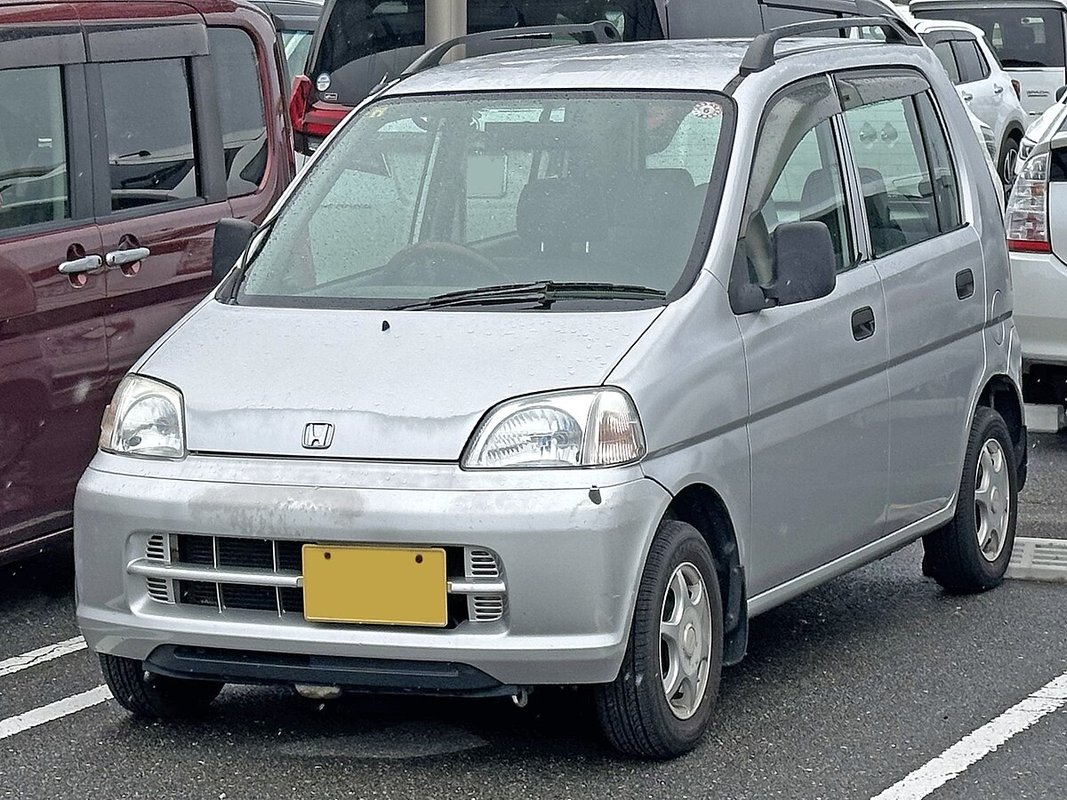
Honda Life 2. generace (1997-1998)
Návrat značky Life po více než 20 letech.
Znovuzrození
Po více než 20leté pauze se Honda Life vrátila jako moderní kei vůz.
Přehled
The Honda Life is an automobile nameplate that was used on various kei car / city cars produced by Honda : passenger cars, microvans , and kei trucks . The first series of the nameplate was built between 1971 and 1974, with the nameplate revived in 1997 and used until 2014. The Japanese-market Life has rarely been marketed outside Japan.
In 2020, Dongfeng Honda revived the "Life" nameplate in China as a rebadged variant of the Fit produced by Guangqi Honda .
The original Life range was offered as a two-door or four-door sedan and in a three-door wagon model (also sold as a commercial van), replacing the Honda NIII360 . Compared with the previous Honda minicar series, passenger comfort was improved to make this a better family car - indeed, Honda's target was to make a kei which was as habitable as a period 1-litre car. The wheelbase, at 2,080 mm (82 in), was eight cm longer than that of the predecessor. The entire Life range had a water-cooled Honda EA 356 cc engine, usually producing 30 PS (30 hp; 22 kW) at 8,000 rpm. which began as the air-cooled engine borrowed from the Honda CB450 motorcycle . The top speed of the sedan is 105 km/h (65 mph). The sprint to 100 km/h (62 mph) came up in 34.9 seconds in a period test. In September 1972, the tall and curiously shaped "Life Step Van" was introduced, with either three or five doors. A pickup version of this was later added to the lineup, but had minimal impact on the market.
The engine was also installed with a balance shaft to reduce vibration. The engine was called "refined" in period tests, and was considered to be as quiet and smooth as some four-cylinder engines. The change to a water-cooled engine also eliminated the smell in the heating system commonly associated with air-cooled engines that drew the heated air into the passenger compartment. Another improvement was that the gearbox was separate from the engine, unlike in the N-series where the gearbox was in the sump (as for the original Mini ). Production of the Life coincided with the larger Honda Civic with both vehicles having introduced a timing belt (rather than chain) for the operation of the overhead cam.
Zdroje
Tento článek obsahuje informace z anglické Wikipedie, dostupné pod licencí CC BY-SA 3.0.