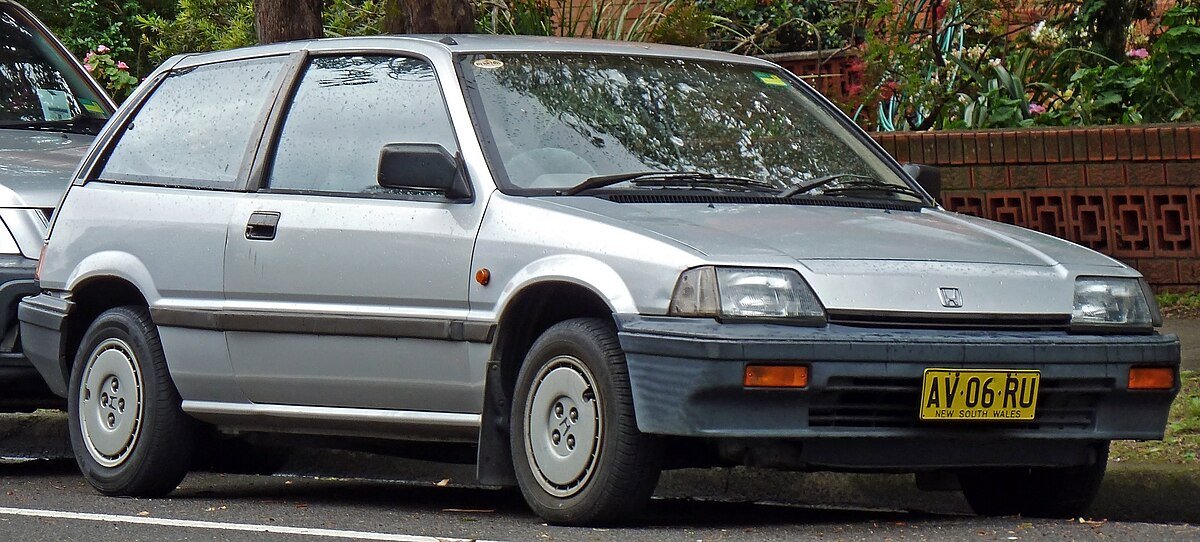
Honda Civic 3. generace (1983-1987) – Wonder Civic
Třetí generace "Wonder Civic" přinesla revoluční design a stala se základem pro legendární CRX.
Wonder Civic
Třetí generace Civic, známá jako "Wonder Civic" v Japonsku, představovala radikální designový posun. Nízká přední kapota, velká skla a aerodynamický tvar předznamenaly budoucnost kompaktních vozů.
CRX - Sportovní derivát
Na základě platformy Civic vznikl legendární Honda CRX, kompaktní kupé s výjimečnou ovladatelností.
Motorizace
- 1.3L CVCC - 60 k
- 1.5L CVCC - 76 k
- 1.5L CVCC-II - 91 k
Přehled
The third-generation Honda Civic is an automobile which was produced by Honda from 1983 until 1987. It was introduced in September 1983 for the 1984 model year. The Civic's wheelbase was increased by 2–5 inches (5.1–12.7 cm) to 93.7 inches (238 cm) for the hatchback or 96.5 inches (245 cm) for the sedan. A three-door hatchback / kammback , four-door sedan (also known as the Honda Ballade ), the five-door "Shuttle" station wagon , and sporting CRX coupé shared common underpinnings. This included MacPherson strut suspension with torsion bars in the front and a rear beam with coil springs. However, the body panels were largely different between models. The Civic-based Honda Quint five-door hatchback also underwent a model change, and became the Honda Quint Integra , available as both a three- and five-door fastback. The Quint Integra (soon just "Integra") was sold at the Japanese Honda Verno dealership along with the CR-X. The Civic in Japan was now exclusive to Honda Primo , along with Honda's kei cars as well as superminis like the Honda City .
At its introduction in 1983, it won the Car of the Year Japan Award.
The sedan and hatchback shared the same dashboard, but the CRX and wagons both had their own unique dash (CRX having a covered cubby in the middle of the dash, the wagon having a pop up set of vents which could be used or retracted into the dash). The hatchback adopted a flatter roof over the rear seats, drawing influences from a bodystyle known in Europe as a shooting-brake , that seemed to blur the definition between traditionally defined hatchbacks and the shooting brake. The flat roof, three-door hatchback appearance was also used on the supermini Honda City , and the Honda Today , the car that returned Honda to kei car production. This appearance was also used on the Honda Accord Aerodeck . The Honda CR-X was the only three-door hatchback that adopted a fastback, sloping rear hatch, demonstrating a performance car appearance identified with Honda Verno products during the mid-1980s. In Europe , a British-built version of the sedan model was also sold, as the Rover 213/216 , while in Japan it was marketed in parallel (through "Verno" dealers) as the Honda Ballade . Both the Sedan and Hatchback models were also sold in Indonesia under the name Civic "Wonder".
A new 12-valve (three valves per cylinder) 76 hp, 1,500 cc inline-four engine was introduced. The base hatchback and CRX 1.3 used the 1,300 cc 8-valve engine giving 60 hp (45 kW). The DX and 1500 S model hatchbacks shared the new 1,500 cc engine with the sedan, wagon, and CRX 1.5. The 1500S model achieved over 50 mpg‑US (4.7 L/100 km; 60 mpg‑imp) highway.
Zdroje
Tento článek obsahuje informace z anglické Wikipedie, dostupné pod licencí CC BY-SA 3.0.